Why Gulf HNW Investors Still Buy in London: The Case for UK Property in 2026

Gulf HNW investors continue to buy in London despite lower yields than Dubai because London offers sterling-denominated capital safety, the deepest residential property liquidity in the world, proximity to UK educational institutions, and established legal frameworks for generational wealth transfer. The 2025 UK non-dom reform changes the tax planning calculus but does not eliminate the strategic case for London ownership.
Key takeaways
- 1London prime residential yields 3 to 4.5% gross. Dubai equivalents yield 6 to 9%. The yield gap is structural, not temporary.
- 2Sterling has acted as a safe-haven currency for AED and SAR-pegged capital across multiple regional and global stress periods.
- 3Proximity to UK boarding schools and universities is a primary driver for Gulf family buyers, not yield.
- 4The 2025 non-dom reform replaced domicile-based taxation with a 4-year FIG (Foreign Income and Gains) regime for new arrivals.
- 5Knightsbridge, Mayfair, Belgravia, and St John's Wood remain the prime Gulf-buyer corridors in London.
Introduction
Gulf HNW investors continue to buy in London despite lower yields than Dubai because London offers sterling-denominated capital safety, the deepest residential property liquidity in the world, proximity to UK educational institutions, and established legal frameworks for generational wealth transfer. The 2025 UK non-dom reform changes the tax planning calculus but does not eliminate the strategic case for London ownership.
Why do Gulf HNW investors continue to buy in London despite lower yields than Dubai?
Gulf HNW investors continue to buy in London because the decision is not primarily about yield. The case for London rests on four pillars: sterling-denominated capital safety in a fully liquid market, proximity to UK educational institutions for children and grandchildren, established legal frameworks for trust and estate structuring, and the deepest pool of professional services (legal, tax, banking) supporting cross-border family wealth. Yield is a fifth-order consideration.
London prime residential has historically preserved real capital value across multiple stress periods, including the 2008 financial crisis, the Brexit transition, and the post-pandemic interest rate environment. The market is deep enough that even significant Gulf positions can be entered and exited without moving the price. This liquidity is structurally absent from emerging Gulf markets and from many other prime global cities.
“Gulf families I know in London bought their first property to be near a school. They bought their third property because London works as a long-term anchor for family wealth in a way no other city does. The yield calculation never drove the decision, and pretending it should is the mistake of advisors who do not understand the buyer.”
How does the 2025 UK non-dom reform affect Gulf investors buying in London?
The April 2025 UK reform abolished the historical domicile-based remittance basis and replaced it with a 4-year Foreign Income and Gains (FIG) regime. New UK residents (including Gulf nationals relocating to the UK) are exempt from UK tax on foreign income and gains for their first four UK tax years, after which worldwide taxation applies. The reform makes long-term UK tax residency materially more expensive for Gulf families who relocate, but it does not change the position for Gulf nationals who hold UK property as non-residents.
For a Gulf national who buys London property without becoming UK tax resident, UK tax exposure is limited to UK rental income (taxed under the Non-Resident Landlord Scheme), UK capital gains tax on disposal of UK property, and UK inheritance tax on UK situs assets at death. None of these are changed by the non-dom reform. The reform affects how a Gulf family plans for eventual UK residency, not how they own UK property as non-residents.
Gulf families considering relocation should model the post-2025 tax position with named UK tax counsel before completing the move. The 4-year FIG window is generous on entry but creates a cliff edge at year 5 that benefits from forward planning.
What are the residency and education benefits of UK property for Gulf families?
UK property ownership does not directly grant residency. The UK Investor Visa programme closed to new applicants in February 2022. UK residency for Gulf nationals is now achieved through the Innovator Founder visa, Skilled Worker visa, or family routes. However, UK property ownership is consistently the practical anchor for Gulf families educating children in UK boarding schools and universities, providing accommodation, an asset base, and visible UK presence.
The most common Gulf family structure is to buy a London property in proximity to a chosen UK boarding school or university, often before the child enrolls. The property serves as the family residence during school holidays, the child's accommodation at university age, and a long-term capital asset. The school choice typically drives the property submarket: families targeting Westminster, Eton, or Harrow have different London catchment preferences than families targeting Oxford or Cambridge.
Which London areas are most popular with Gulf HNW buyers and why?
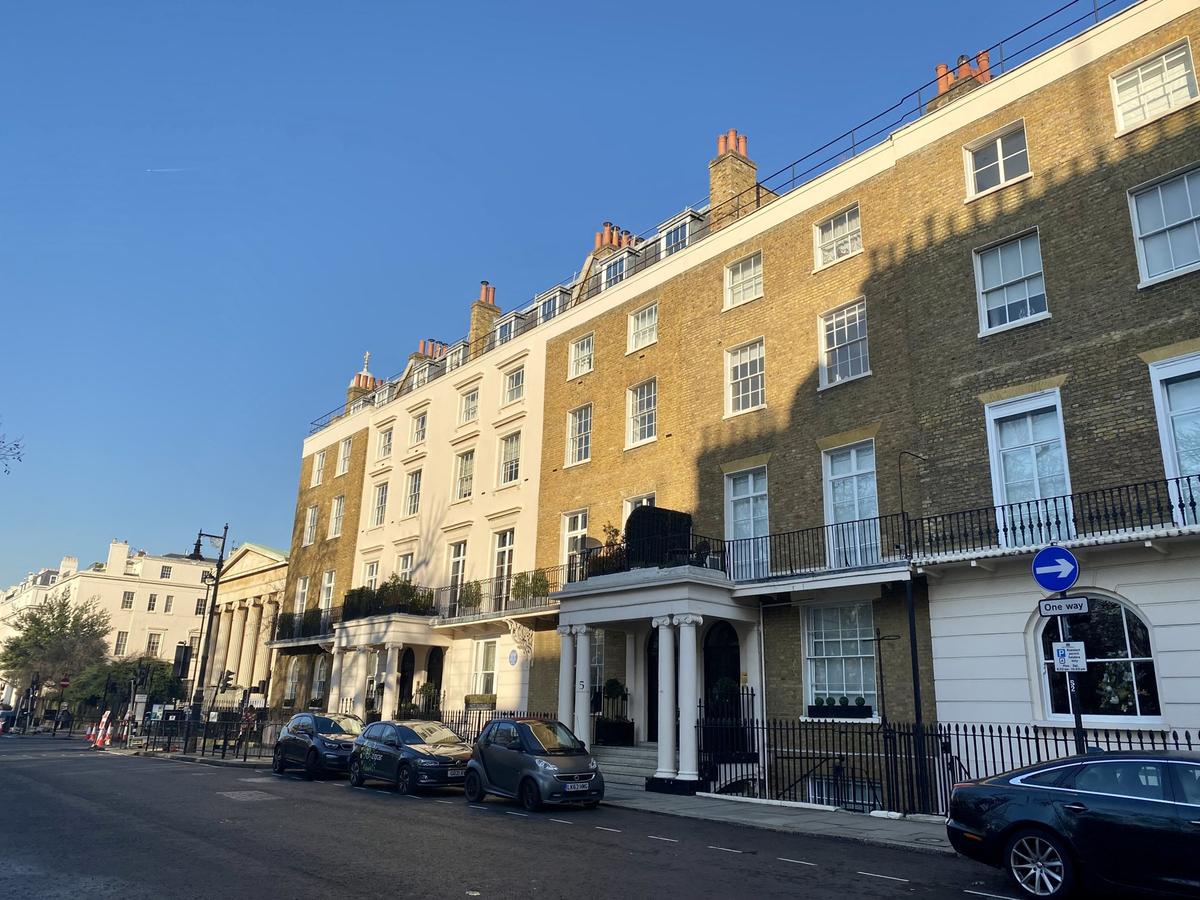
Knightsbridge, Mayfair, Belgravia, and St John's Wood are the four established London corridors for Gulf HNW buyers. Each has different characteristics: Knightsbridge for retail and family-led lifestyle, Mayfair for prestige and proximity to Park Lane, Belgravia for residential calm with central access, and St John's Wood for school catchment and family-suitable property stock. All four trade at GBP 2,500 to 5,000+ per square foot.
Newer Gulf buyer activity has expanded into Marylebone, Notting Hill, and parts of Kensington that offer family-suitable property at GBP 1,800 to 3,000 per square foot. These submarkets are less established as Gulf corridors but offer better entry value and stronger ongoing demand from a broader buyer pool, which supports exit liquidity. Intric's London curation includes both prime-prime and prime-emerging submarkets.
| Area | Price per sqft | Gross yield | Buyer profile | Established |
|---|---|---|---|---|
| Knightsbridge | GBP 3,000-5,000 | 2.5-3.5% | Lifestyle + retail | Long-established |
| Mayfair | GBP 3,500-5,500 | 2.5-3.5% | Prestige + business | Long-established |
| Belgravia | GBP 2,800-4,500 | Discreet family | Long-established | |
| St John's Wood | GBP 1,800-3,000 | School catchment | Long-established | |
| Marylebone | GBP 1,800-2,800 | 2.5-3.5% | ||
| 3.5-4.5% | 3.5-4.5% | Family + mixed | Emerging |
How do Gulf families structure London property for generational transfer?
Generational transfer planning for UK property held by Gulf families typically uses one of three structures: direct individual ownership with a UK will, ownership through a UK trust (subject to the relevant UK trust taxation regime), or ownership through an offshore corporate vehicle in Jersey or BVI. Each structure has different inheritance tax, capital gains tax, and ongoing administration cost implications. UK inheritance tax at 40% above the nil-rate band applies to UK property regardless of the owner's domicile.
The choice of structure depends on the size of the UK property exposure, the number of heirs, the family's broader tax residency planning, and whether the property is intended for use by future generations or as a pure investment. Gulf families with multiple UK properties often use a holding company structure to consolidate ownership; families with a single primary residence often use individual ownership with a UK will and life insurance to fund the eventual IHT liability.
How does London compare to Dubai for capital safety and yield?
London offers deeper market liquidity, longer track record of capital preservation through stress periods, and more established legal protections for foreign owners. Dubai offers higher gross yields, zero personal income tax on rental income, zero capital gains tax on property disposal, and a residency pathway through property investment. The two markets serve complementary roles in a Gulf HNW portfolio rather than competing for the same allocation.
Most Gulf HNW investors who buy in London also hold Dubai property. The London position serves capital preservation, education, and generational anchoring. The Dubai position serves yield, currency-of-residence convenience, and residency optionality. Comparing the two on yield alone misses the structural reason both exist in the same portfolio.
Frequently asked questions
Do Gulf nationals need a UK visa to buy property in London?+
What is the total UK stamp duty for a Gulf non-resident buying a GBP 5 million London home?+
Does the 2025 non-dom reform affect Gulf nationals who own UK property without UK residency?+
Is London property still a good investment for Gulf families in 2026?+
Does Intric work with Gulf-based investors on London property?+
This content is AI-generated and may contain errors. Figures are indicative and subject to change. Do your own due diligence and seek independent legal and financial advice.

Abhii Dabas is the Founder and CEO of INTRIC Global, the cross-border property intelligence platform for serious investors. He advises high-net-worth buyers on international real estate strategy and has evaluated residential markets across more than 40 countries.
Share
Share this article with others
Gulf HNW investors continue to buy in London despite lower yields than Dubai because London offers sterling-denominated capital safety, the deepest residential property liquidity in the world, proximity to UK educational institutions, and established legal frameworks for generational wealth transfer. The 2025 UK non-dom reform changes the tax planning calculus but does not eliminate the strategic case for London ownership.
Key takeaways
- 1London prime residential yields 3 to 4.5% gross. Dubai equivalents yield 6 to 9%. The yield gap is structural, not temporary.
- 2Sterling has acted as a safe-haven currency for AED and SAR-pegged capital across multiple regional and global stress periods.
- 3Proximity to UK boarding schools and universities is a primary driver for Gulf family buyers, not yield.
- 4The 2025 non-dom reform replaced domicile-based taxation with a 4-year FIG (Foreign Income and Gains) regime for new arrivals.
- 5Knightsbridge, Mayfair, Belgravia, and St John's Wood remain the prime Gulf-buyer corridors in London.
Introduction
Gulf HNW investors continue to buy in London despite lower yields than Dubai because London offers sterling-denominated capital safety, the deepest residential property liquidity in the world, proximity to UK educational institutions, and established legal frameworks for generational wealth transfer. The 2025 UK non-dom reform changes the tax planning calculus but does not eliminate the strategic case for London ownership.
Why do Gulf HNW investors continue to buy in London despite lower yields than Dubai?
Gulf HNW investors continue to buy in London because the decision is not primarily about yield. The case for London rests on four pillars: sterling-denominated capital safety in a fully liquid market, proximity to UK educational institutions for children and grandchildren, established legal frameworks for trust and estate structuring, and the deepest pool of professional services (legal, tax, banking) supporting cross-border family wealth. Yield is a fifth-order consideration.
London prime residential has historically preserved real capital value across multiple stress periods, including the 2008 financial crisis, the Brexit transition, and the post-pandemic interest rate environment. The market is deep enough that even significant Gulf positions can be entered and exited without moving the price. This liquidity is structurally absent from emerging Gulf markets and from many other prime global cities.
“Gulf families I know in London bought their first property to be near a school. They bought their third property because London works as a long-term anchor for family wealth in a way no other city does. The yield calculation never drove the decision, and pretending it should is the mistake of advisors who do not understand the buyer.”
How does the 2025 UK non-dom reform affect Gulf investors buying in London?
The April 2025 UK reform abolished the historical domicile-based remittance basis and replaced it with a 4-year Foreign Income and Gains (FIG) regime. New UK residents (including Gulf nationals relocating to the UK) are exempt from UK tax on foreign income and gains for their first four UK tax years, after which worldwide taxation applies. The reform makes long-term UK tax residency materially more expensive for Gulf families who relocate, but it does not change the position for Gulf nationals who hold UK property as non-residents.
For a Gulf national who buys London property without becoming UK tax resident, UK tax exposure is limited to UK rental income (taxed under the Non-Resident Landlord Scheme), UK capital gains tax on disposal of UK property, and UK inheritance tax on UK situs assets at death. None of these are changed by the non-dom reform. The reform affects how a Gulf family plans for eventual UK residency, not how they own UK property as non-residents.
Gulf families considering relocation should model the post-2025 tax position with named UK tax counsel before completing the move. The 4-year FIG window is generous on entry but creates a cliff edge at year 5 that benefits from forward planning.
What are the residency and education benefits of UK property for Gulf families?
UK property ownership does not directly grant residency. The UK Investor Visa programme closed to new applicants in February 2022. UK residency for Gulf nationals is now achieved through the Innovator Founder visa, Skilled Worker visa, or family routes. However, UK property ownership is consistently the practical anchor for Gulf families educating children in UK boarding schools and universities, providing accommodation, an asset base, and visible UK presence.
The most common Gulf family structure is to buy a London property in proximity to a chosen UK boarding school or university, often before the child enrolls. The property serves as the family residence during school holidays, the child's accommodation at university age, and a long-term capital asset. The school choice typically drives the property submarket: families targeting Westminster, Eton, or Harrow have different London catchment preferences than families targeting Oxford or Cambridge.
Which London areas are most popular with Gulf HNW buyers and why?
Knightsbridge, Mayfair, Belgravia, and St John's Wood are the four established London corridors for Gulf HNW buyers. Each has different characteristics: Knightsbridge for retail and family-led lifestyle, Mayfair for prestige and proximity to Park Lane, Belgravia for residential calm with central access, and St John's Wood for school catchment and family-suitable property stock. All four trade at GBP 2,500 to 5,000+ per square foot.
Newer Gulf buyer activity has expanded into Marylebone, Notting Hill, and parts of Kensington that offer family-suitable property at GBP 1,800 to 3,000 per square foot. These submarkets are less established as Gulf corridors but offer better entry value and stronger ongoing demand from a broader buyer pool, which supports exit liquidity. Intric's London curation includes both prime-prime and prime-emerging submarkets.
| Area | Price per sqft | Gross yield | Buyer profile | Established |
|---|---|---|---|---|
| Knightsbridge | GBP 3,000-5,000 | 2.5-3.5% | Lifestyle + retail | Long-established |
| Mayfair | GBP 3,500-5,500 | 2.5-3.5% | Prestige + business | Long-established |
| Belgravia | GBP 2,800-4,500 | Discreet family | Long-established | |
| St John's Wood | GBP 1,800-3,000 | School catchment | Long-established | |
| Marylebone | GBP 1,800-2,800 | 2.5-3.5% | ||
| 3.5-4.5% | 3.5-4.5% | Family + mixed | Emerging |
How do Gulf families structure London property for generational transfer?
Generational transfer planning for UK property held by Gulf families typically uses one of three structures: direct individual ownership with a UK will, ownership through a UK trust (subject to the relevant UK trust taxation regime), or ownership through an offshore corporate vehicle in Jersey or BVI. Each structure has different inheritance tax, capital gains tax, and ongoing administration cost implications. UK inheritance tax at 40% above the nil-rate band applies to UK property regardless of the owner's domicile.
The choice of structure depends on the size of the UK property exposure, the number of heirs, the family's broader tax residency planning, and whether the property is intended for use by future generations or as a pure investment. Gulf families with multiple UK properties often use a holding company structure to consolidate ownership; families with a single primary residence often use individual ownership with a UK will and life insurance to fund the eventual IHT liability.
How does London compare to Dubai for capital safety and yield?
London offers deeper market liquidity, longer track record of capital preservation through stress periods, and more established legal protections for foreign owners. Dubai offers higher gross yields, zero personal income tax on rental income, zero capital gains tax on property disposal, and a residency pathway through property investment. The two markets serve complementary roles in a Gulf HNW portfolio rather than competing for the same allocation.
Most Gulf HNW investors who buy in London also hold Dubai property. The London position serves capital preservation, education, and generational anchoring. The Dubai position serves yield, currency-of-residence convenience, and residency optionality. Comparing the two on yield alone misses the structural reason both exist in the same portfolio.
Frequently asked questions
Do Gulf nationals need a UK visa to buy property in London?+
What is the total UK stamp duty for a Gulf non-resident buying a GBP 5 million London home?+
Does the 2025 non-dom reform affect Gulf nationals who own UK property without UK residency?+
Is London property still a good investment for Gulf families in 2026?+
Does Intric work with Gulf-based investors on London property?+
This content is AI-generated and may contain errors. Figures are indicative and subject to change. Do your own due diligence and seek independent legal and financial advice.
Sources
Abhii Dabas is the Founder and CEO of INTRIC Global, the cross-border property intelligence platform for serious investors. He advises high-net-worth buyers on international real estate strategy and has evaluated residential markets across more than 40 countries.
Share this article
Share this insight with others
Share
Share this article with others
Related Market Insights
View More Market Insights
Investment Guide
Buying Property in Australia in 2026: A Guide for Indonesian and Malaysian Investors
By Abhii Dabas · July 17, 2026
Investment Guide
Buying Prime London Property in 2026: A Guide for Gulf Family Investors
By Abhii Dabas · July 17, 2026

Investment Guide
Singapore Investors Buying in Japan: The 2026 Guide to Tokyo and Osaka Property
By Abhii Dabas · July 16, 2026
Found this useful? Send it to someone who should read it.
Continue with INTRIC